

Buyer guide with Colleen Olivas
FHA or Conventional? How to Choose (2026)
By Colleen Olivas, NMLS #379721, who started in escrow and worked her way through every role in mortgages, up to underwriter. The Brandon Drew Group, a division of New American Funding Last reviewed November 2026
Quick answer
FHA loans are insured by the federal government and are often more flexible with credit, and HUD doesn't require you to be a first-time buyer. Conventional loans follow Fannie Mae and Freddie Mac rules, and their private mortgage insurance can come off as you pay down the loan. Which one fits depends on your credit, your savings, the home and how long you'll keep the loan. Ask your lender to show you both, side by side. Subject to eligibility and lender approval.

Key points
- HUD says FHA doesn't require you to be a first-time buyer.
- FHA is often more flexible with credit. HUD says it "offers loans to borrowers with limited to no credit, and with less than perfect credit history."
- Both loans can come with smaller down payment options for buyers who qualify. Conventional has several, including Freddie Mac's HomeOne for first-time buyers, which has no income limit.
- Mortgage insurance works differently. Conventional PMI can be cancelled as you pay down the loan. FHA's annual premium lasts for a set time or the life of the loan, depending on your down payment.
- Loan limits differ by county and by loan type. 2026 figures for Southern California are below.
- CalHFA offers both an FHA and a conventional first mortgage, so the choice comes up with CalHFA too.
On this page (8 sections)
The two loans in plain words
FHA. HUD explains that "FHA insures mortgages made by FHA-approved lenders," and because of that insurance "the lender is able to offer more flexible terms that make it easier for borrowers to qualify." You pay for it with mortgage insurance: an upfront premium at closing, which HUD says "may be financed into the mortgage," and an annual premium paid monthly.
Conventional. A conventional loan isn't insured by the government. Conforming conventional loans follow Fannie Mae or Freddie Mac rules, within FHFA's loan limits. With a smaller down payment, you'll usually pay private mortgage insurance (PMI) until you've paid the loan down far enough to remove it.
Side by side
FHA
- Who backs itInsured by the Federal Housing Administration (HUD)
- CreditFlexible. HUD: loans for borrowers "with limited to no credit, and with less than perfect credit history"
- First-time buyer?Not required (HUD)
- Down paymentA low minimum, and it can be a gift from family, an employer or a charity (HUD)
- Mortgage insuranceUpfront premium (can be financed) plus an annual premium paid monthly
- When the insurance endsAfter a set number of years with a larger down payment; otherwise for the life of the loan. Paying extra doesn't end it early (HUD)
- 2026 one-unit loan limit: Riverside and San Bernardino Counties$690,000
- 2026 one-unit loan limit: Los Angeles and Orange Counties$1,249,125
- CalHFA versionCalHFA offers an FHA first mortgage
Conventional
- Who backs itNot government-insured; conforming loans follow Fannie Mae or Freddie Mac rules
- CreditFannie Mae: "A minimum credit score is not required for DU loan casefiles"; manually underwritten loans have their own minimums
- First-time buyer?Not required for most loans. Some smaller down payment options are for first-time buyers
- Down paymentSeveral smaller down payment options for buyers who qualify (see below). Ask your lender how gifts work for the option you use
- Mortgage insurancePMI with a smaller down payment
- When the insurance endsYou can ask to cancel it on schedule, and in general it ends automatically later (see below)
- 2026 one-unit loan limit: Riverside and San Bernardino Counties$832,750
- 2026 one-unit loan limit: Los Angeles and Orange Counties$1,249,125
- CalHFA versionCalHFA offers a conventional first mortgage
Loan limits change every year. FHFA announced the 2026 limits on November 25, 2025; check each agency's page for next year's. Sources: FHFA's 2026 county list and HUD's 2026 FHA county file.
Smaller down payment options on conventional
Many buyers hear that conventional means a big down payment. Not always. Fannie Mae and Freddie Mac each have options for buyers who qualify:
- Fannie Mae's standard option for first-time buyers. For its smallest down payments on a purchase, Fannie's rules say "at least one borrower must be a first-time homebuyer."
- Freddie Mac HomeOne. For first-time homebuyers, "regardless of their income levels or geographic location," per Freddie Mac. It's a fixed-rate loan for a one-unit home you'll live in, and homebuyer education is required when every borrower is a first-time buyer.
- Fannie Mae HomeReady and Freddie Mac Home Possible. For buyers with lower incomes, with income limits set by where the home is. Freddie Mac says Home Possible's "Qualifying income is limited to 80% of area median income (AMI)"; Fannie Mae describes HomeReady as "for low-income borrowers" and publishes its limits in its Area Median Income Lookup Tool. Freddie Mac says Home Possible's down payment "can come from a variety of sources, including family."
Each one has its own credit, property and education rules, and the smallest down payments come with mortgage insurance. Ask your lender to run the options you qualify for next to an FHA loan.
Mortgage insurance: how it ends
Conventional (PMI). The CFPB explains that "You have the right to ask your servicer to cancel PMI on the date the principal balance of your mortgage is scheduled to fall to 80 percent of the original value of your home." To get it granted, you ask in writing, have a good payment history, have no junior liens, and show the home's value hasn't dropped. Even if you don't ask, "in general, your servicer must automatically terminate PMI on the date when your principal balance is scheduled to reach 78 percent of the original value of your home."
FHA (MIP). HUD says the annual premium lasts for a set number of years if you started with a larger down payment, and otherwise for the life of the loan. HUD's page has the exact cutoff. "Borrowers may not request early cancellation of Annual MIP based on prepayment of principal." Paying off the FHA loan ends its premium. Whether refinancing later makes sense depends on qualifying and the costs at that time.
Is FHA only for first-time buyers?
No. HUD says it "does not require that a Borrower be a First-Time Homebuyer in order to qualify for an FHA loan." Some down payment assistance programs do require first-time buyer status, and they set their own definitions.
Why didn't my lender mention conventional (or FHA)?
If you were shown only one option, you can ask to see both. A good comparison puts each loan's Loan Estimate side by side: the mortgage insurance and how long it lasts, the closing costs, and the rate. If one doesn't fit you, your lender should be able to tell you why.
Rates: is one loan type better?
We don't publish rates, and the rate alone doesn't tell you which loan costs less. HUD notes that "FHA does not set the interest rates on the mortgages it insures," and advises you to "compare mortgages from several different lenders." Compare the whole cost: the rate, the mortgage insurance and how long it lasts, and the closing costs. Ask each lender for a Loan Estimate for both loans and lay them side by side.
How to choose
- Check your credit. If your credit is limited or has bumps, FHA may be more forgiving.
- Count your savings and any gift. HUD says FHA allows gifts from family, an employer or a charity. Ask how gifts work for the conventional options you qualify for.
- Think about how long you'll keep the loan. PMI can come off a conventional loan. FHA's annual premium follows HUD's schedule above.
- Check the price against the limits. Each county has a limit for each loan type (see the table).
- Ask about CalHFA. CalHFA has both an FHA and a conventional first mortgage, and its down payment help works with them. See CalHFA first-time buyer loans.
- Get both on paper. A Loan Estimate for each shows the real difference.
The bottom line
Neither loan is always better. FHA often helps when credit is limited or has bumps. Conventional often wins when you want mortgage insurance that can come off. A good lender shows you both and lets the numbers decide. Bring your questions and we'll walk through both with you, including when the right answer is to wait.
Your next step
Talk it through with Colleen
A short call helps you know what to ask and what to have ready. No pressure.
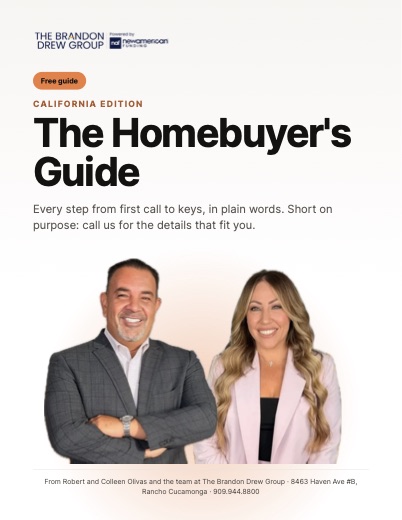 Free guide · PDF · California editionThe Homebuyer's Guide
Pre-approval, CalHFA, GSFA and the other down payment programs, in plain words. Read it at your own pace.
Download the free guide
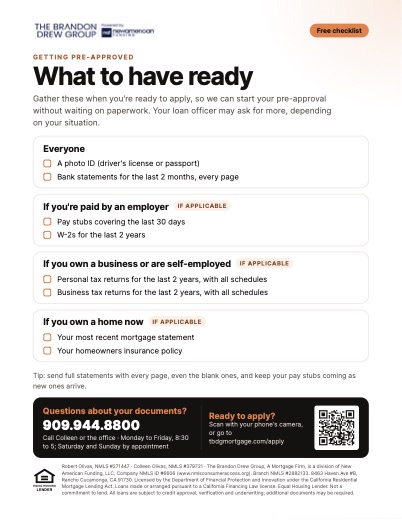 Free checklist · PDF · one pageWhat to have ready
The documents to gather when you're ready to apply, so we can start your pre-approval without waiting on paperwork.
Download the checklist
Questions buyers ask
What's the difference between FHA and conventional?
FHA loans are insured by the Federal Housing Administration, and HUD says FHA offers loans to borrowers "with limited to no credit, and with less than perfect credit history." Conventional loans aren't government-insured; conforming loans follow Fannie Mae or Freddie Mac rules. The biggest practical differences are credit flexibility, how mortgage insurance works and how long it lasts, and the loan limits in your county.
→ Read: What an underwriter looks for
Is it true I can get a conventional loan with a small down payment?
Yes, for buyers who qualify. Fannie Mae and Freddie Mac each have smaller down payment options, including Freddie Mac's HomeOne for first-time buyers, which has no income limit, and some (HomeReady, Home Possible) for buyers with lower incomes, with limits set by area. Each has its own rules, and a smaller down payment usually means mortgage insurance.
→ Read: Credit score minimums for FHA, conventional, VA and CalHFA
When can I remove PMI or FHA mortgage insurance?
For conventional PMI, the CFPB says you can ask to cancel when your balance is scheduled to fall to 80 percent of the home's original value, and it generally ends automatically at 78 percent. FHA's annual premium follows HUD's rules: a set number of years with a larger down payment, otherwise the life of the loan, and paying extra doesn't end it early.
→ Read: FHA loans in the Inland Empire
Can I finance FHA's upfront mortgage insurance?
Yes. HUD says the upfront premium "may be financed into the mortgage." Financing it means you pay it over time, with interest, instead of at closing.
→ Read: FHA loans in the Inland Empire
If I choose conventional, can I still use FHA later?
Choosing one loan today doesn't by itself stop you from using the other on a future home. You'd need to qualify under that loan's rules at the time, so ask your lender about your situation.
Does CalHFA require mortgage insurance?
It depends on the first mortgage. CalHFA offers an FHA first mortgage, which carries FHA's mortgage insurance, and a conventional first mortgage with its own mortgage insurance rules. Ask us how each works for you.
→ Read: CalHFA first-time buyer loans
Sources13 sources · show all
Every official site we use is also on one page: Official sources we use and trust.
Sources re-checked November 8, 2026.
Check each page directly. Rules and limits change. HUD, CFPB and Freddie Mac pages were read November 7, 2026; the Fannie Mae pages and the HUD and FHFA limit files were read by our research helpers the same day and get re-checked in Safari on publish day.
- HUD, How does HUD define a First-Time Homebuyer?: https://answers.hud.gov/FHA/s/article/How-does-HUD-define-a-first-time-homebuyer
- HUD, How can FHA help me buy a home?: https://answers.hud.gov/FHA/s/article/How-can-FHA-help-me-buy-a-home
- HUD, FHA Mortgage Insurance Premium structure: https://answers.hud.gov/FHA/s/article/What-is-the-FHA-Mortgage-Insurance-Premium-structure-for-forward-mortgage-loans
- HUD, How long is MIP collected (case numbers on or after June 3, 2013): https://answers.hud.gov/FHA/s/article/How-long-is-MIP-collected-for-case-numbers-assigned-on-or-after-June-3-2013
- HUD, How do I calculate the loan amount for an FHA purchase (financing the upfront premium): https://answers.hud.gov/FHA/s/article/How-do-I-calculate-the-loan-amount-for-an-FHA-purchase-transaction
- HUD, 2026 FHA county limits file: https://apps.hud.gov/pub/chums/cy2026-forward-limits.txt
- FHFA, 2026 conforming loan limits: https://www.fhfa.gov/news/news-release/fhfa-announces-conforming-loan-limit-values-for-2026 and county list: https://www.fhfa.gov/data/conforming-loan-limit
- CFPB, When can I remove private mortgage insurance (PMI)?: https://www.consumerfinance.gov/ask-cfpb/when-can-i-remove-private-mortgage-insurance-pmi-from-my-loan-en-202/
- Freddie Mac, HomeOne: https://sf.freddiemac.com/working-with-us/origination-underwriting/mortgage-products/home-one
- Freddie Mac, Home Possible: https://sf.freddiemac.com/working-with-us/origination-underwriting/mortgage-products/home-possible
- Fannie Mae Selling Guide, B3-5.1-01 (credit scores), B2-1.3-01 (purchase transactions), B5-6-01 (HomeReady): https://selling-guide.fanniemae.com/
- Fannie Mae, HomeReady Mortgage (read November 8, 2026): https://singlefamily.fanniemae.com/originating-underwriting/mortgage-products/homeready-mortgage
- NMLS Consumer Access: https://www.nmlsconsumeraccess.org
Disclosures
Colleen Olivas, NMLS #379721. Robert Olivas, NMLS #271447. The Brandon Drew Group, a division of New American Funding, LLC, Company NMLS ID #6606 (www.nmlsconsumeraccess.org). Branch NMLS #2882133. 8463 Haven Avenue, Suite B, Rancho Cucamonga, CA 91730.
Equal Housing Lender.
Licensed by the Department of Financial Protection and Innovation under the California Residential Mortgage Lending Act. Loans made or arranged pursuant to a California Financing Law license.
This is for information only. It is not a commitment to lend or a rate quote. Loan programs, limits and mortgage insurance rules can change without notice. Loans are subject to credit approval and underwriting, and not every borrower qualifies for every option. We are not affiliated with or endorsed by HUD, FHA, Fannie Mae or Freddie Mac. For licensing information, visit www.nmlsconsumeraccess.org.